
Property for Rent in Abu Dhabi Outshines Dubai for Renters in 2026
· 22 min read
Introduction: Why Expand Your Rental Search Beyond Dubai
When most people think about renting in the UAE, Dubai is the first place that comes to mind. And that makes sense. Dubai has a huge rental market with endless options. But here is the thing: sticking only to Dubai means you could miss out on some really good deals in other emirates.
Abu Dhabi, the capital, offers a different kind of lifestyle. It is quieter, more spacious, and often more affordable than Dubai. Yet many tenants overlook the capital’s rental market simply because they do not know what is available or how easy the process can be. The truth is, Abu Dhabi’s rental market is heating up. According to a report from Khaleej Times, average apartment rents in Abu Dhabi surged by 10% in early 2025. And the trend is continuing into 2026. Bayut’s latest rental market report shows that mid-tier apartment rents increased anywhere from 5% to 25% in different areas.
So why limit yourself? Whether you are looking for a property for rent in Abu Dhabi, a house for rent in Sharjah, a villa for rent in Ajman, or even a one bedroom flat in Ajman monthly rent option, expanding your search can unlock more space for your money and a calmer lifestyle away from the hustle of Dubai.

This guide gives you consolidated, trustworthy data to help you make an informed decision. We cover everything from rental prices and popular areas to tips for negotiating your lease. If you already have experience renting in Dubai, you might find it useful to compare the process. Check out our guide on how to rent property in Dubai without getting overcharged to see how the two markets stack up. For official market data, the Abu Dhabi Real Estate Centre provides reliable analytics on rental trends.
Let us explore why Abu Dhabi and other emirates deserve a spot on your rental shortlist in 2026.
Why Look Beyond Dubai? The Case for Abu Dhabi and Other Emirates
So why would you want to look beyond Dubai for your next rental? The short answer is that your money often goes further. And you get a different pace of life that many people actually prefer.
Let us start with Abu Dhabi. The capital offers lower rental costs per square foot compared to prime Dubai locations. You can find a spacious two-bedroom apartment in Abu Dhabi City for an average annual rent of around AED 83,027, according to figures from Global Property Guide. Compare that to similar sized units in popular Dubai neighborhoods, and you will see a clear difference. Even though Abu Dhabi rents are rising, they still offer better value. A Khaleej Times report notes that average apartment rents surged 10% in early 2025, and the trend continues into 2026. Bayut’s latest market report confirms that mid-tier apartment rents increased 5% to 25% in different areas, but prices remain attractive relative to Dubai.
Beyond the price tag, there is the quality of life factor. Apartments and villas in Abu Dhabi tend to be larger. You get more square footage for your dirham. The city is greener, less congested, and offers a calmer environment. If you work in Abu Dhabi’s key employment hubs, living there cuts your commute dramatically. It is a trade-off many expats find worthwhile.

Now, the other emirates deserve serious attention too. If you are looking for a house for rent in Sharjah, you will find significantly cheaper options than in Dubai. Sharjah rental yields in 2026 range from AED 18,000 to AED 28,000 for studios, as reported by Gaia Realty. That is a fraction of what you would pay in Dubai for similar space. Ajman is even more budget-friendly. A one bedroom flat in Ajman monthly rent might cost you as little as AED 1,800 to AED 3,500 per month, depending on the area. And if you want extra space for a family, a villa for rent in Ajman can be found for very competitive rates.
Ras Al Khaimah is also gaining traction. Its average rental yields for apartments are 8 to 10%, much higher than Dubai’s 3 to 5% returns, according to Top Luxury Property. That makes RAK a smart choice for investors, but also for tenants who want more nature and less noise.
The bottom line? Expanding your search beyond Dubai opens the door to better value, more space, and a lifestyle that suits your needs. If you are still unsure how to evaluate fair rents across emirates, our guide on how to use the rental index Dubai for fair rent in 2026 can help you compare apples to apples. And for official Abu Dhabi market trends, check the Abu Dhabi Real Estate Centre data directly.

Whether you are hunting for a house on rent in Abu Dhabi or exploring other emirates, 2026 is a great year to find a deal that fits your budget and life.
Abu Dhabi: A Deep Dive into the Capital’s Rental Market
Abu Dhabi isn’t just a quieter, more affordable alternative to Dubai. It has its own distinct rental market with neighborhoods that suit different lifestyles and budgets. Whether you are a young professional, a growing family, or an investor looking for yield, the capital offers something real.
Let’s break down the key districts and what you can expect to pay in 2026.
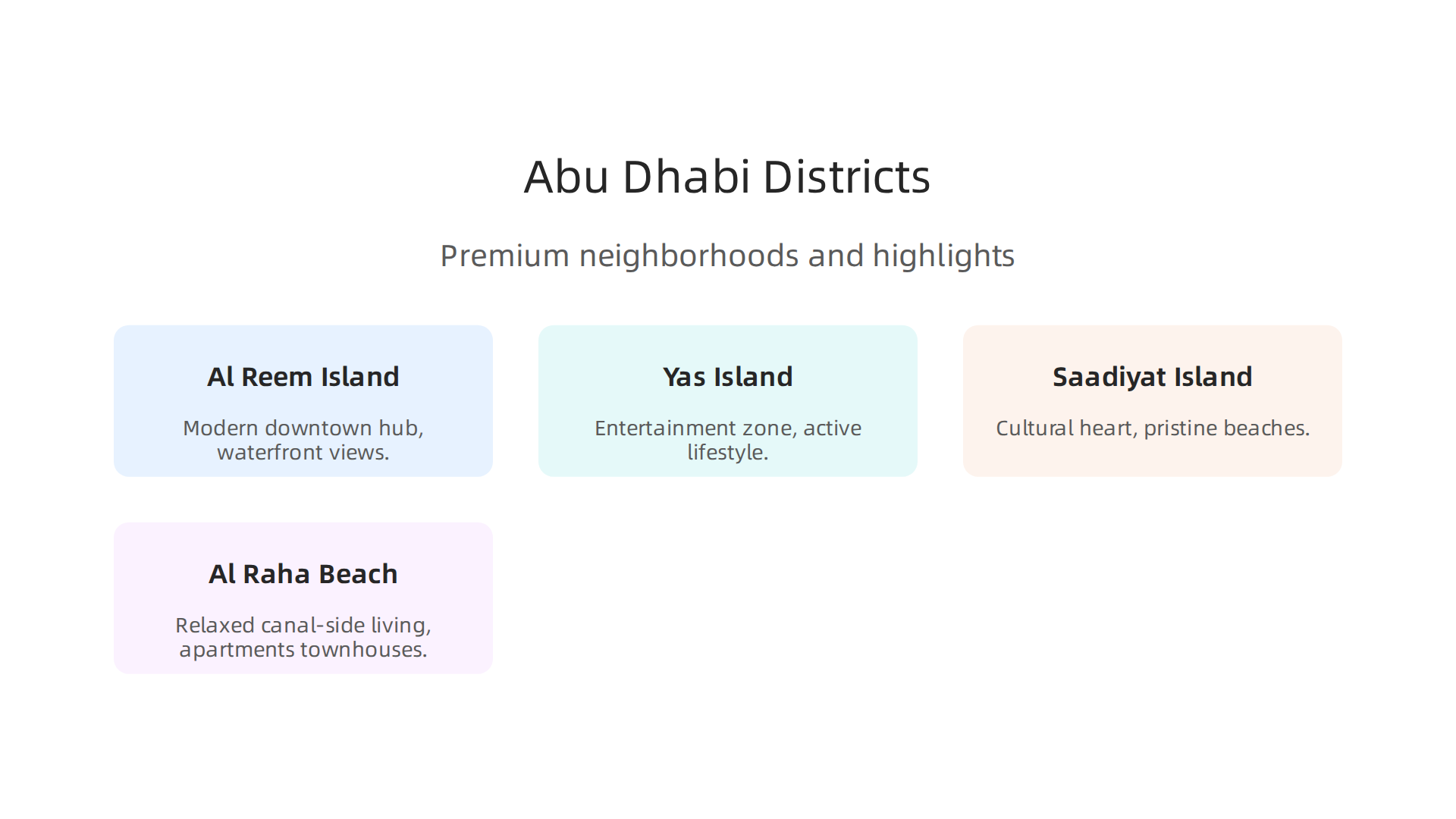
Luxury Districts: Al Reem Island, Yas Island, Saadiyat Island, and Al Raha Beach
If you want premium living, these are the places to look.
-
Al Reem Island is a modern downtown hub with high-rise towers, waterfront views, and close proximity to the city center. Its mix of studios and one to three-bedroom apartments is popular with professionals.
-
Yas Island is the entertainment zone. You get apartments and villas near Ferrari World, Yas Marina, and the beach. It is ideal if you love an active lifestyle.
-
Saadiyat Island is the cultural heart. It has luxury apartments and villas near the Louvre Abu Dhabi and pristine beaches. Rents here are among the highest in the city.
-
Al Raha Beach offers a more relaxed canal-side living with a mix of apartments and townhouses.
Average annual rents for luxury apartments in 2026 (approximate):
| Unit Type | Al Reem Island | Yas Island | Saadiyat Island |
|---|---|---|---|
| Studio | AED 55,000 – 70,000 | AED 60,000 – 80,000 | AED 70,000 – 90,000 |
| 1-bedroom | AED 75,000 – 95,000 | AED 85,000 – 110,000 | AED 100,000 – 130,000 |
| 2-bedroom | AED 105,000 – 140,000 | AED 120,000 – 160,000 | AED 150,000 – 190,000 |
| 3-bedroom | AED 150,000 – 200,000 | AED 170,000 – 230,000 | AED 220,000 – 300,000 |
These figures are based on market listings and reports from sources like Bayut’s Abu Dhabi Rental Market Report and Engel & Völkers, which confirm mid-tier rents increased 5% to 25% in various areas. The luxury segment is stable but demands have risen, according to a Khaleej Times report on Abu Dhabi rents surging up to 12% in early 2025, and the trend continues into 2026.
Mid-Range Districts: Khalifa City and Mohammed Bin Zayed City
For families and renters who want more space without breaking the bank, these neighborhoods deliver.
-
Khalifa City is a sprawling suburban area with villas and lower-rise apartment blocks. It is popular with families because of its schools, parks, and quiet streets.
-
Mohammed Bin Zayed City (MBZ City) offers larger villas and apartments at budget-friendly prices. It is a bit further from the city center but well-connected.
Average annual rents for mid-range apartments (2026):
| Unit Type | Khalifa City | MBZ City |
|---|---|---|
| Studio | AED 30,000 – 40,000 | AED 25,000 – 35,000 |
| 1-bedroom | AED 40,000 – 55,000 | AED 35,000 – 45,000 |
| 2-bedroom | AED 55,000 – 75,000 | AED 45,000 – 60,000 |
| 3-bedroom | AED 75,000 – 100,000 | AED 60,000 – 80,000 |
These mid-range areas offer much better value than comparable properties in Dubai. A two-bedroom in MBZ City costs about the same as a studio in many Dubai neighbourhoods.
Short-Term vs Long-Term Rentals
The market has two clear trends in 2026. First, long-term rental demand is strong. According to Sands of Wealth’s Abu Dhabi real estate market analysis, rents increased over 20% year-on-year in late 2025, driven by professionals moving to the capital. Second, short-term rentals (like Airbnb) are popular in luxury districts like Saadiyat and Yas Island, especially for tourists. But new supply from completed projects is starting to cool prices in some segments. The Abu Dhabi Real Estate Centre provides official data to track these shifts.
So what does this mean for you? If you are looking for a property for rent in Abu Dhabi, start by deciding your lifestyle. Do you want luxury near culture? Go Saadiyat. Do you want suburban calm? Go Khalifa City. And do not forget to check your rights. Our guide on how to rent property in Dubai in 2026 without getting overcharged has tips that apply in Abu Dhabi too.
Abu Dhabi’s rental market in 2026 is competitive but still offers great value compared to Dubai. With the right area, you can get more space and a calmer life for your dirham.
Abu Dhabi vs Dubai: Head-to-Head Comparison for Renters
You have seen the numbers. Abu Dhabi gives you more space for less money. But money is only part of the story. If you are deciding between the two cities, you need to look at the full picture.

Here is how they stack up in 2026.
Cost of Living and Rent
Let us start with the big question. How much cheaper is Abu Dhabi really?
According to Numbeo’s cost of living comparison, rent in Abu Dhabi is about 15.7% lower than Dubai when you factor everything in. Property Finder’s analysis puts the gap even wider, saying Dubai rents can be 20% to 40% higher for a comparable apartment. That matches what we saw earlier in our luxury district pricing tables.
But here is the thing. Utilities can vary. Bayut’s breakdown of living costs notes that while Abu Dhabi housing is cheaper, some costs like electricity can be slightly higher due to the city’s layout and older building stock in certain areas. Still, the overall Expatistan comparison shows Abu Dhabi is roughly 12% cheaper across the board.
If you are looking for a house on rent in Abu Dhabi, you will likely get a villa with a garden for the same price as a smaller apartment in a mid-tier Dubai neighborhood.
Contract and Legal Differences
This one trips up a lot of renters moving between cities.
In Dubai, you register your tenancy contract through Ejari. In Abu Dhabi, you use Tawtheeq. Both systems protect your rights, but they work differently.
- Tawtheeq is linked directly to Abu Dhabi’s Department of Municipalities and Transport. It handles rent disputes and registration all in one place.
- Ejari is managed by Dubai’s Real Estate Regulatory Authority (RERA).
The key difference? Abu Dhabi’s system is simpler for renters. You can register your contract online without needing a broker or typing center in most cases. That saves time and money.
Before you sign anything, make sure you understand how these systems affect your deposit and renewal terms. Our guide on how to rent property in Dubai in 2026 without getting overcharged covers negotiation tips that work for both cities.
Lifestyle and Daily Life
This is where the two cities truly diverge.
| Factor | Abu Dhabi | Dubai |
|---|---|---|
| Commute time | Shorter, less traffic | Longer, more congestion |
| Schools | Good options, fewer choices | Wider variety, more international schools |
| Entertainment | Cultural focus, quieter | Non-stop events, nightlife |
| Green space | More parks, corniche | More malls, man-made attractions |
| Pace | Relaxed, family-oriented | Fast, busy |
A Chelsea Properties comparison confirms that Abu Dhabi is cheaper for housing and transport, while Dubai offers more dining and entertainment variety.
So which one is right for you? If you want a calmer life with more space for your money, Abu Dhabi wins. If you want endless options for going out and a faster career pace, Dubai may be better.
The Bottom Line for Renters
Here is a simple way to decide. Ask yourself these questions:
- Do you value space and quiet over nightlife? Go Abu Dhabi.
- Do you need to commute to Dubai for work? Think carefully about the 90-minute drive each way.
- Are you a family looking for good schools and parks? Both work, but Abu Dhabi gives you better value.
For many renters, the smart play is to find a property for rent in Abu Dhabi for daily life while enjoying Dubai on weekends. You save on rent, enjoy a calmer home, and still have access to everything Dubai offers when you want it.
And if you are thinking about buying instead of renting, check out our step-by-step guide on how to buy property in Dubai in 2026. The same due diligence applies in Abu Dhabi.
The choice between these two cities comes down to what matters most to you. In 2026, Abu Dhabi gives you more home for your money. Dubai gives you more action. Both are great. Pick the one that fits your life.
How to Rent in Abu Dhabi: Step-by-Step Legal Guide
If you have decided that Abu Dhabi is your city, or you just want to understand the process, here is a step-by-step guide to renting legally in 2026.
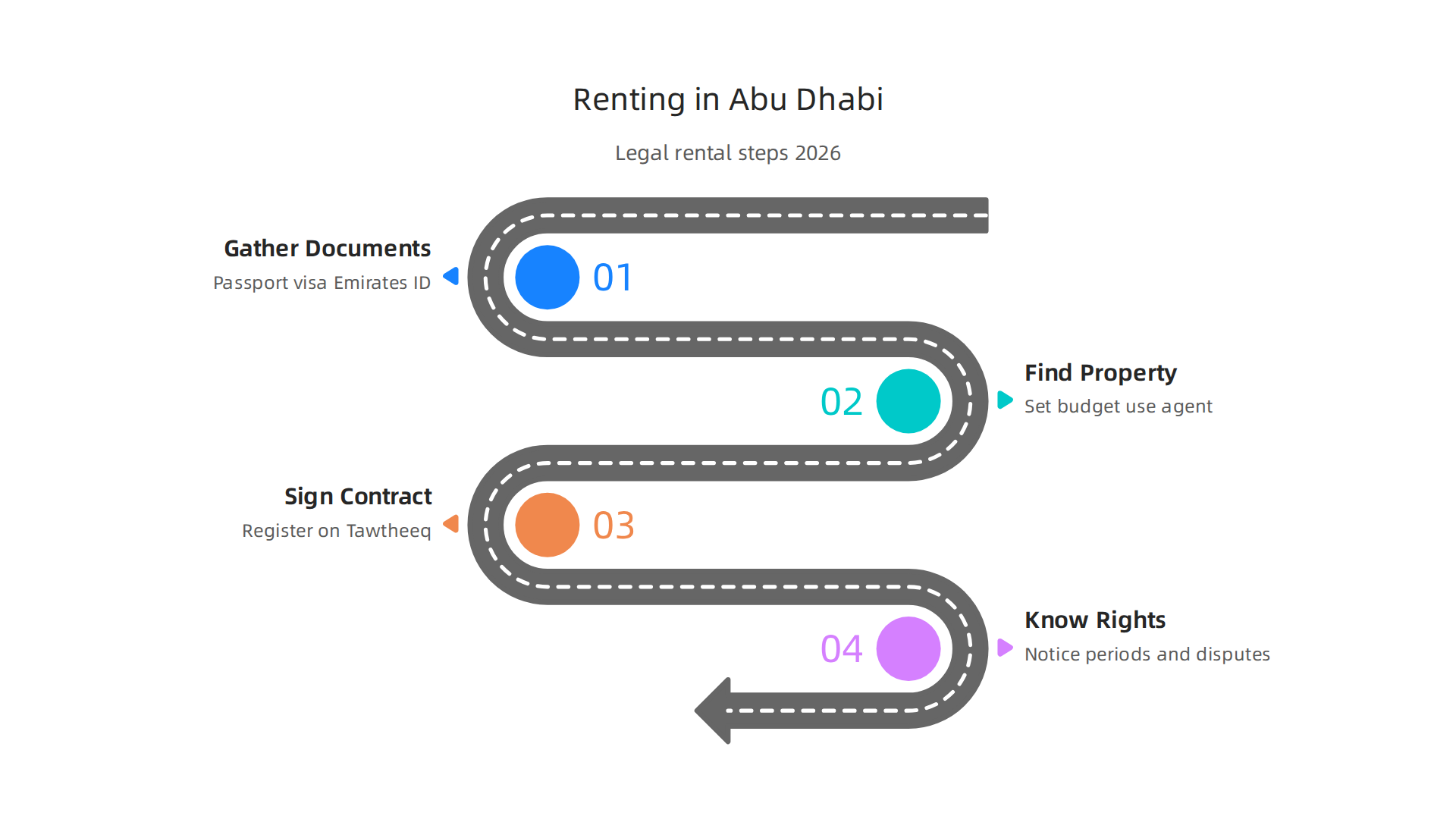
The system is simpler than Dubai’s in some ways, but you still need to get the details right.
Step 1: Gather Your Documents
Before you even start looking at apartments or villas, get your paperwork ready. Landlords and agents will ask for these right away. According to Bayut’s guide on renting in Abu Dhabi, you will need:
- A valid passport copy
- Your UAE residency visa
- Your Emirates ID
- Marriage certificate (if you are renting with a spouse)
- A recent tenancy contract from your previous landlord (if you are moving within Abu Dhabi)
Make sure your Emirates ID is not expired. If your visa is still being processed, some landlords may accept a visa stamping letter, but most prefer the final document.
Step 2: Find a Property and Understand Your Budget
Once your documents are ready, start looking for a property for rent in Abu Dhabi. Use platforms like Property Finder or Bayut, or work with a registered agent. Set a budget that includes more than just the rent.
Typical costs for a standard apartment or house on rent in Abu Dhabi include:
| Cost | Typical Amount |
|---|---|
| Security deposit | 5% of annual rent |
| Municipality fees | 3% of annual rent |
| Tawtheeq registration fee | Around AED 200 |
| Agency fee | Usually 5% of annual rent |
Payment schedules vary. Most landlords accept between 4 and 12 post-dated cheques. Four to six cheques is common for higher-end properties. For a villa for rent in Ajman or a one bedroom flat in Ajman monthly rent, you might find more flexible payment terms, but Abu Dhabi is generally landlord-friendly on cheques.
Step 3: Sign the Tenancy Contract and Register on Tawtheeq
After you agree on a price, you will sign a tenancy contract. In Abu Dhabi, you must register this contract on the Tawtheeq system. Tawtheeq is run by the Department of Municipalities and Transport (DMT).
Registering is straightforward. You can do it online through the Tawtheeq website or app. You will upload your documents and pay the fee. Once registered, your contract is legally binding and protected.
Step 4: Know Your Tenant Rights
Abu Dhabi’s rental laws are clear. According to the Abu Dhabi Tenants Guide 2026, landlords must give at least 6 months’ written notice before eviction for personal use. Unlike Dubai (which requires 12 months), Abu Dhabi law requires only 2 months’ notice for a tenant to vacate at the end of a contract, as long as it is in writing.
If you have a dispute, you can take it to the Abu Dhabi Rental Dispute Settlement Committee. The Keyper guide on Abu Dhabi rental laws explains that rent increases are capped based on a calculator similar to RERA’s in Dubai. If your landlord tries to raise the rent unfairly, you have the right to challenge it.
Step 5: Compare with Other Options
While Abu Dhabi offers great value, some renters consider even cheaper alternatives. If you are looking for a house for rent in Sharjah, you can find lower rents but sacrifice commute time to Abu Dhabi or Dubai. Similarly, a one bedroom flat in Ajman monthly rent can be very affordable, but Ajman lacks the amenities and job market of the capital.
For most people in 2026, a property for rent in Abu Dhabi strikes the best balance between cost, space, and lifestyle.
If you want to understand how rental indices work to ensure you are paying a fair price, check out our guide on how to use the rental index in Dubai for fair rent in 2026. The same principles apply in Abu Dhabi through the DMT’s own rental index.
Once you have your contract registered and your keys in hand, you are set. Abu Dhabi’s rental process is efficient if you follow these steps. Take your time, get your documents straight, and know your rights.
Rental Costs and Market Trends: What You Need to Know in 2026
Now that you know how to rent in Abu Dhabi, let’s talk money. What can you expect to pay in 2026? And are prices going up or down? Here is the real picture.
Rents in Abu Dhabi have been climbing. According to the Khaleej Times report on rental surges, average apartment rental rates jumped 10 percent year-on-year in early 2025. That trend continued into 2026. The Sands of Wealth market analysis shows rents increased over 20 percent year-on-year in late 2025 and early 2026.
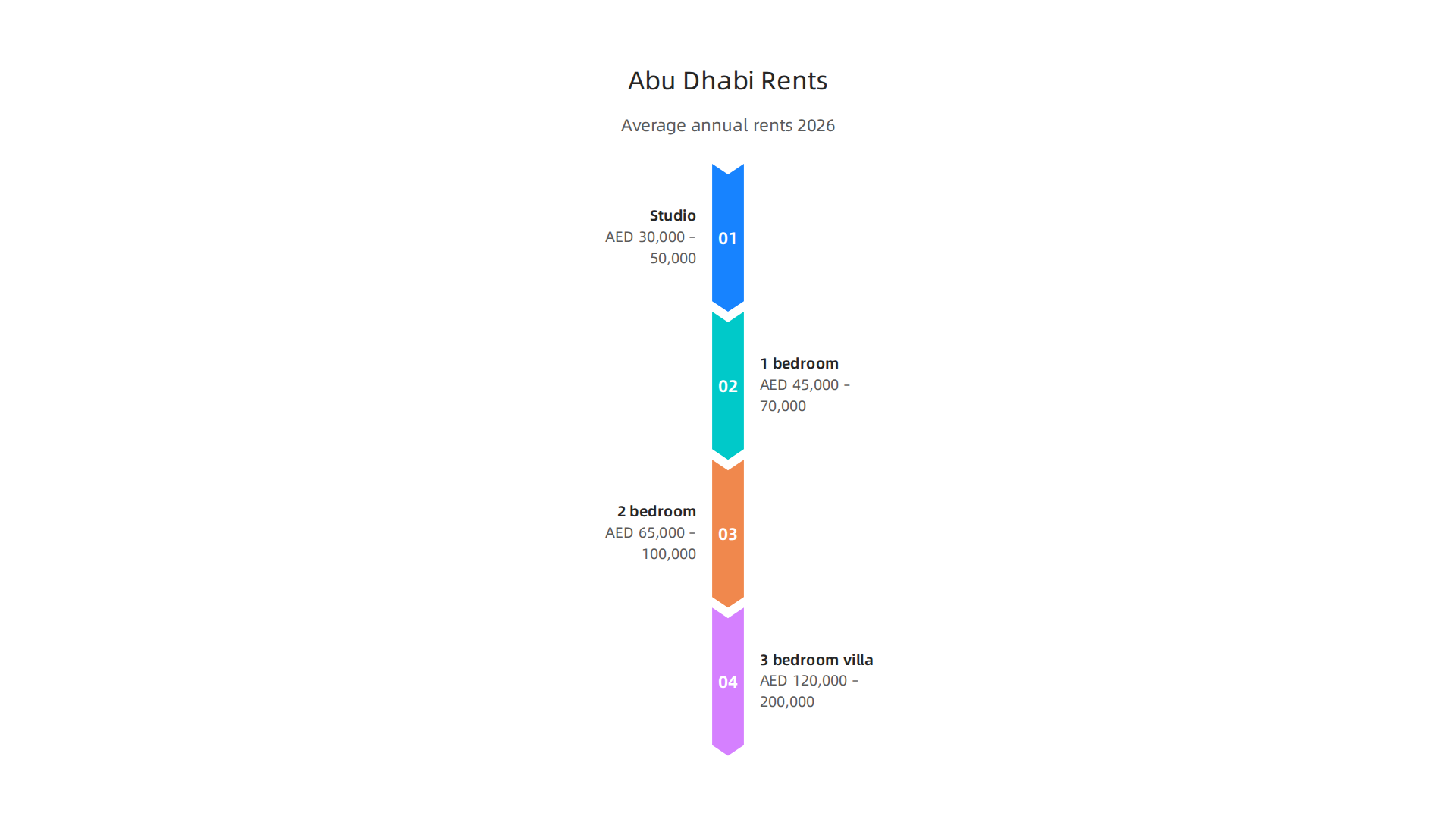
Here is a simple breakdown of what you will pay today for a property for rent in Abu Dhabi:
| Unit Type | Average Annual Rent (AED) |
|---|---|
| Studio | 30,000 – 50,000 |
| 1 bedroom | 45,000 – 70,000 |
| 2 bedroom | 65,000 – 100,000 |
| 3 bedroom villa | 120,000 – 200,000 |
Prices vary by location. Al Reem Island and Yas Island are on the higher end. Khalifa City and Al Shawamekh offer lower rates. The Bayut Abu Dhabi Rental Market Report for 2025 confirms mid-tier apartment rentals rose between 5 percent and 25 percent across different areas.
How does this compare to Dubai? Simply put, Abu Dhabi is cheaper. The Property Finder comparison shows rents in Dubai can be 20 to 40 percent higher for a similar apartment. Numbeo’s cost of living data says rental costs in Dubai are about 15.7 percent higher overall. So if you compare a house on rent in Abu Dhabi with one in Dubai, you save real money.
But here is the thing. Even with these increases, Abu Dhabi is still more affordable than options like a house for rent in Sharjah or a villa for rent in Ajman. Those areas are cheaper per square foot, but you lose the lifestyle and job access of the capital.
What is driving these price rises? Three main factors stand out in 2026.
First, new project completions are limited. The Engel & Völkers Abu Dhabi market analysis notes that supply is tight in popular areas. Fewer units being handed over means more competition for existing stock. Second, Abu Dhabi’s economy is diversifying. More companies are setting up in the city, bringing in professionals who need housing. Third, new regulations from the Abu Dhabi Real Estate Centre (ADREC) are making the market more transparent. You can check official market data from ADREC to see current rental indices and trends.
What does this mean for you in 2026? If you are looking for a property for rent in Abu Dhabi, expect to pay more than last year. But you are still getting better value than Dubai. And if you are considering a one bedroom flat in Ajman monthly rent to save money, weigh the commute and lifestyle tradeoffs. Abu Dhabi’s rental market is heating up, but it remains a smart choice.
For a deeper look at how rental indices work and how to check if you are being charged a fair price, check out our guide on how to rent property in Dubai in 2026 without getting overcharged. The same principles apply in Abu Dhabi through the ADREC rental index. If you are thinking long term, you might even consider how to buy property in Dubai in 2026 as an alternative to renting.
Bottom line: Abu Dhabi rents are rising, but they are still reasonable. Know the numbers, compare your options, and make a choice that fits your budget and lifestyle.
Exploring Other Emirates: Sharjah, Ajman, and Ras Al Khaimah
If Abu Dhabi is not quite right for your budget or lifestyle, you have other options in the UAE. Three emirates stand out for renters in 2026: Sharjah, Ajman, and Ras Al Khaimah. Each has its own pros and cons.
Sharjah is a popular choice for families. It is more affordable than Abu Dhabi or Dubai, and it is close to Dubai for work commutes. In 2026, you can find a house for rent in Sharjah starting around AED 18,000 for a studio and up to AED 28,000 for a one bedroom, according to the Gaia Realty comparison of Ajman vs Sharjah. The catch? Sharjah has stricter rules. No alcohol is allowed in homes, and some areas have conservative dress codes. But if you want a quieter, family-friendly environment, Sharjah works well.
Ajman offers the lowest rental costs in the UAE. The Global Business Outlook report on real estate investors shows average annual rents between AED 22,000 and AED 42,000 for apartments. That means you can get a one bedroom flat in Ajman monthly rent for as little as AED 1,800. The expat community is growing, and you will find basic amenities. But high end options are limited. If you are looking for a villa for rent in Ajman, expect older properties with fewer luxury features.
Ras Al Khaimah is the emerging star. The Cavendish Maxwell data cited by Zawya shows apartment prices rose 13.4% year on year in 2025, with villa prices up nearly 10%. RAK is known for its natural scenery, mountains, and beaches. You can find freehold areas for long term leases, and tourism drives short term rentals. Rental yields are higher here, around 8 10%, compared to 3 5% in Dubai (Top Luxury Property analysis). So if you want both a home and an investment, RAK is worth a look.
So which one is right for you? If you need to be near Dubai and want low costs, try Sharjah or Ajman. If you prefer nature and good returns, check out Ras Al Khaimah. And remember, even with rising rents in Abu Dhabi, you still have more choices than you think. For a step by step guide on renting anywhere in the UAE, including how to avoid overpaying, our guide on how to rent property in Dubai in 2026 without getting overcharged is a helpful read. The same principles apply across the Emirates.
Essential Tips for International Tenants in the UAE
Moving to a new country is exciting, but renting your first home here comes with a learning curve. The good news is that with a few insider tips, you can avoid common mistakes and feel confident.

Whether you are searching for a property for rent Abu Dhabi or a house on rent in Abu Dhabi, these pointers will help you settle in smoothly.
Respect local customs and time your lease right
The UAE has a rich culture that shapes daily life. During the holy month of Ramadan, working hours change and eating or drinking in public during daylight is not allowed. Many landlords also set lease dates around the Islamic calendar. For example, contracts often start or end in September after the summer heat subsides. Understanding this can help you plan your move better. If you want a quick overview of local etiquette, this expat guide to culture in Dubai is a great starting point.
Navigate language barriers in contracts
Most rental contracts are written in both English and Arabic, but Arabic is the legal version if there is a dispute. So before you sign anything, get a certified translator to review the document. Many real estate agents in Abu Dhabi are fluent in English and other languages, but do not rely on verbal promises. Get everything in writing. If you are unsure about any clause, ask your agent to explain it clearly. For a full list of what you need, the Bayut guide on contracts and documents is very helpful.
Visa and residency: your tenancy depends on it
Here is something many newcomers miss. Your tenancy contract is directly tied to your residency visa. You cannot legally rent a property for rent Abu Dhabi without a valid UAE residence visa and Emirates ID. Most landlords will not even let you move in until they see these documents. If you are still waiting for your visa, you might need a temporary arrangement or a hotel apartment first. The Neuk practical guide to renting in Abu Dhabi explains this step in detail. And remember, if your employer changes or your visa expires during the lease term, you may have to break the contract early, which can cost you.
Know your rights and notice periods
Abu Dhabi law is tenant friendly, but you have to follow the rules. For instance, if you want to move out, you must give at least 2 months written notice. Verbal notice does not count. Landlords also need at least 6 months written notice if they want to evict you, as covered in the dubizzle landlord rights guide. These rules are different from Dubai, so do not assume they are the same.
For a deeper look at the entire rental process across the UAE, including how to avoid overpaying, check out our step by step guide on renting in Dubai in 2026 without getting overcharged. The same principles apply to Abu Dhabi and other emirates.
Summary
This article explains why renters should widen their search beyond Dubai and consider Abu Dhabi and the other emirates in 2026. It reviews current market trends and prices, showing that Abu Dhabi generally gives more space for your dirham with mid-tier rents rising between about 5% and 25% but still below comparable Dubai levels. You will find a neighbourhood-by-neighbourhood breakdown—luxury areas like Saadiyat and Yas, mid-range suburbs like Khalifa City and MBZ—and average rent bands for studios through villas. The guide also walks you through the practical rental steps: required documents, security deposits, cheque schedules, and mandatory Tawtheeq registration, plus tenant rights and notice periods. It compares lifestyle, commute and legal differences between Abu Dhabi and Dubai, and looks at cheaper options in Sharjah, Ajman and Ras Al Khaimah. After reading, you will know how to compare fair rents, choose the right area for your needs, and complete a legal tenancy in Abu Dhabi with confidence.